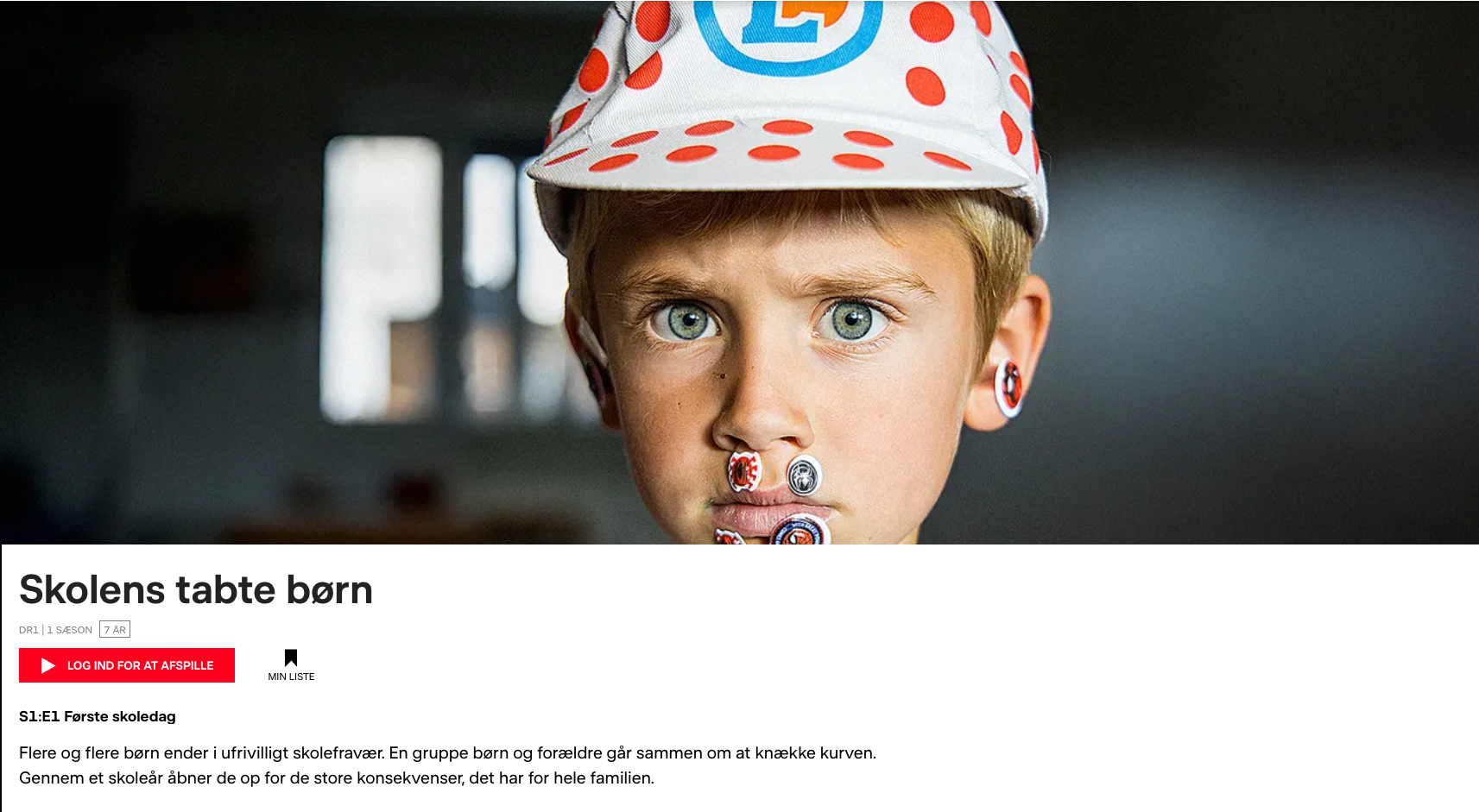
DR shows the documentary series ‘The School’s Lost Children’ in five episodes by Jens Langhorn – about involuntary school absence.
Children with autism have always had a difficult time at school. Already in the 00s, we began to see more children with problems beyond their autism. At the same time, the counties were abolished, specialized knowledge disappeared, the school law and the inclusion reform rolled in at the beginning of the 2010s, and the teacher training colleges closed their special modules.
Today, children grow up with fewer adults in nurseries and kindergartens, more staff changes, and more hours in institutions – something researchers have criticized for years. Bureau 2000 documents that “there are significantly fewer staff hours per child today than 50 years ago – even though the demands on children have grown dramatically.” Psychologist Margrethe Brun Hansen warns that an early start in institutions can challenge attachment and create insecurity.
I myself founded Søstjerneskolen – a highly specialized day treatment school in Copenhagen – because I believed the solution lay in more autism pedagogy. But after eight years as a manager and psychologist responsible for treatment, it became clear:
The children were not just autistic. They were worn out by system stress. They carried anxiety, depression, demand avoidance, eating disorders, and sensory processing disorders – on top of their autism and ADHD.
And what helps is:
• Stable relationships with adults who know autism and can create safety
• School environments that take children’s senses into account and provide enough adult contact
• Time, calm, and continuity, so children’s nervous systems can heal
Many teachers and school leaders are already working hard to create a safe learning environment, but the task is complex, and there are too few of them to do the work. It requires time, planning, and collegial sparring to adapt the teaching, and there must be enough adults in the classroom to help the children through transitions and conflicts.
If we want to succeed, we must give schools more freedom and more resources to organize teaching flexibly. It is not enough to say that teachers “just” need to differentiate – they need concrete tools, supervision, and enough colleagues to carry out the task together.
In my own neurodidactic approach, I teach teachers and educators how they can work consciously with safety and the biology of the nervous system. When one understands this, one can create learning environments that regulate students’ nervous systems, promote calm, and increase children’s ability to learn. This is not just good for children with autism and ADHD – it is good for all children.
I have stopped working at Søstjerneskolen and instead spend time teaching at colleges, in municipalities, and in schools – together with passionate individuals who daily try to reach the children.
There is no shortcut to safety and well-being. Every single child must be seen, acknowledged, and feel wanted. It is not exams and tests that create joy in learning – it is people.
Watch ‘The School’s Lost Children’ – and let us create a safe public school where children do not get sick from system stress and end up as the school’s lost children.